
A portable power station is only as reliable as your ability to recharge it off-grid. While wall charging gets your battery to 100% before heading out, pairing your power station with a high-efficiency foldable solar panel unlocks indefinite runtime for camping trips, overland expeditions, and prolonged home blackouts.
Choosing the right portable panel requires matching connector types (MC4, DC7909, DC8020), open-circuit voltage limits ($V_{oc}$), and wattage ratings to your battery’s internal MPPT charge controller. This guide compares field-tested foldable panels from leading brands to help you maximize solar input in any condition.
Best Foldable Solar Panels: Real-World Specs & Direct Deals
☀️ Best Foldable Solar Panels: Real-World Specs & Direct Deals
How to Size Foldable Solar Panels for Your Generator
A common misconception is that a 100W solar panel will feed 100 watts into your battery continuously. In real-world conditions (ambient heat, angle, and atmosphere), portable panels typically generate 75% to 85% of their rated output.
Here is how to match panel wattage to battery capacity:
Estimated Solar Charge Time = Battery Capacity (Wh) / (Solar Panel Rated Watts * 0.80)
- Entry-Level Power Stations ($200\text{Wh} – 500\text{Wh}$): A single 100W to 120W panel yields $75\text{W}\text{–}95\text{W}$ in direct sun, recharging units like the BLUETTI Elite 30 V2 in roughly 3.5 to 4 hours.
- Mid-Sized Units ($700\text{Wh} – 1,200\text{Wh}$): A 200W panel or two 100W panels in series delivers $150\text{W}\text{–}170\text{W}$, filling mid-range units like the BLUETTI AC180 or Jackery 1000 v2 in roughly 6 to 7 hours of peak daylight.
- High-Capacity Home Backup ($2,000\text{Wh}+$): Large systems require high-output 350W–400W foldable panels or multi-panel arrays wired to handle $500\text{W}\text{–}1,200\text{W}+$ solar inputs.
Top Tested Foldable Solar Panels for 2026
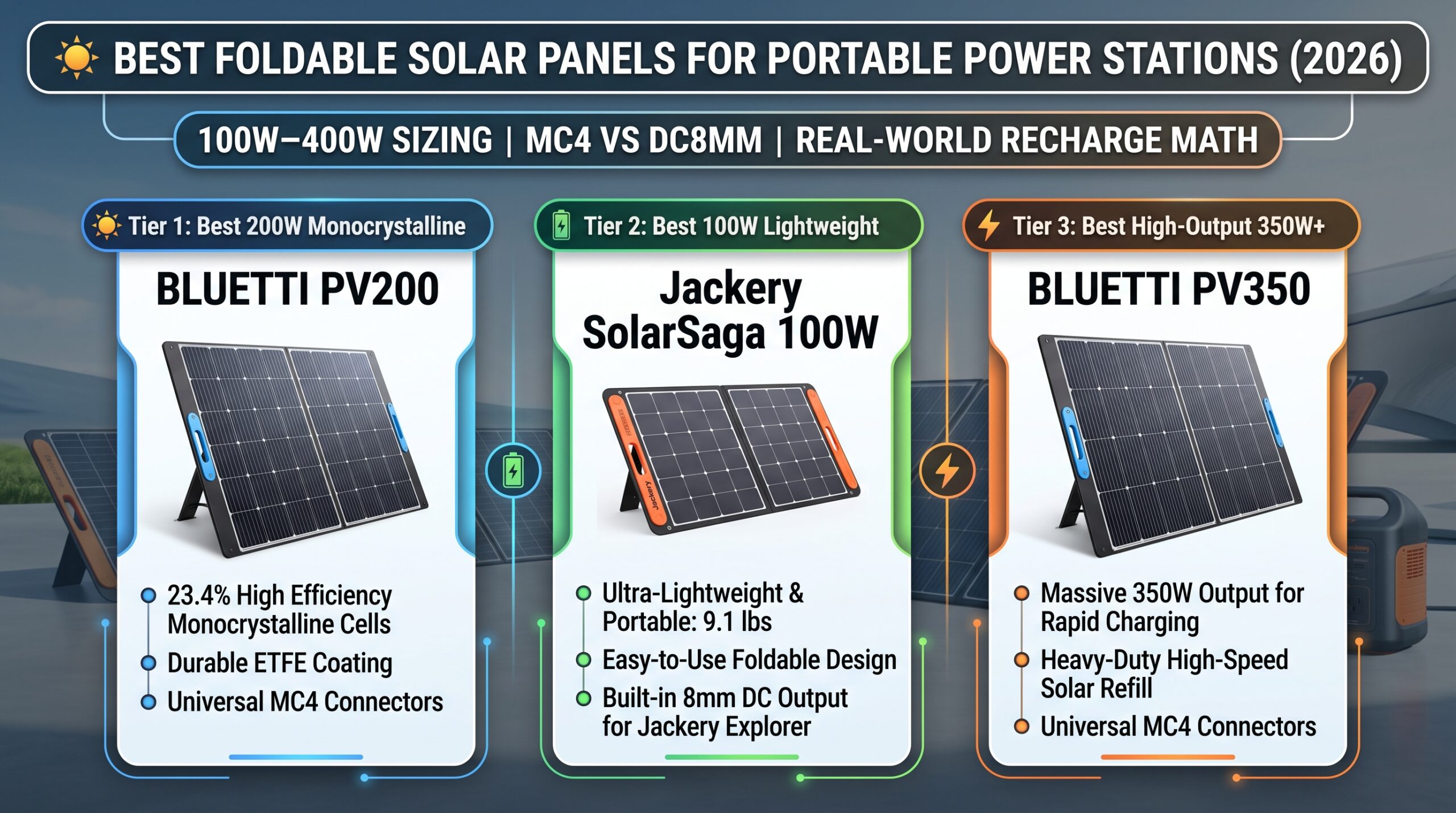
1. Best Overall 200W Pick: BLUETTI PV200
- Rated Output: 200 Watts
- Cell Type & Efficiency: Monocrystalline | Up to 23.4%
- Open Circuit Voltage ($V_{oc}$): 26.1V
- Connector Type: Standard MC4
- Weight: 16.1 lbs (7.3 kg)
- Key Features: Built with long-lasting ETFE coating that resists scratching and water splashes (IP65). The 4-panel folding design includes adjustable kickstands with angle markings ($40^\circ, 45^\circ, 50^\circ$) to maximize sun capture throughout the day. Standard MC4 connectors make it compatible with almost any third-party power station via simple adapter cables.
2. Best Lightweight 100W Camping Pick: Jackery SolarSaga 100W
- Rated Output: 100 Watts
- Cell Type & Efficiency: Monocrystalline | 23%
- Open Circuit Voltage ($V_{oc}$): 21.6V
- Connector Type: Built-in 8mm DC Cable (with USB-A & USB-C ports on junction box)
- Weight: 9.1 lbs (4.1 kg)
- Key Features: One of the easiest panels to pack for weekend trips. Features magnetic closure handles that snap together instantly and an integrated zippered pouch to store cables. Built-in USB output ports allow you to charge phones or flashlights directly from the panel without plugging into a power station.
3. Best High-Output Pick for Large Stations: BLUETTI PV350
- Rated Output: 350 Watts
- Cell Type & Efficiency: Monocrystalline | Up to 23.4%
- Open Circuit Voltage ($V_{oc}$): 46.5V
- Connector Type: MC4
- Weight: 30.6 lbs (13.9 kg)
- Key Features: Designed for high-capacity batteries like the BLUETTI AC200L, AC300, and Elite 400. Delivering upwards of $280\text{W}\text{–}310\text{W}$ in direct sun, a single PV350 panel cuts recharge times on large batteries in half compared to smaller 100W arrays.
Estimated Solar Charge Times Across Popular Batteries
⏱️ Real-World Solar Recharge Time Estimates (Direct Sunlight)
3 Key Factors to Check Before Buying
- Connector Compatibility: Most BLUETTI and heavy-duty stations use universal MC4 connectors. Jackery models use proprietary DC8020 (8mm) ports. Always verify that you have the proper adapter cable included with your power station.
- Voltage Range ($V_{oc}$ Limit): Every power station specifies an MPPT input voltage range (e.g., $12\text{V}\text{–}60\text{V}$). Never connect solar panels whose open-circuit voltage ($V_{oc}$) exceeds your power station’s maximum input limit, as this triggers over-voltage protection.
- ETFE vs. PET Coatings: Look for panels laminated with ETFE rather than cheap PET film. ETFE offers superior light transmittance, higher heat tolerance, and greater resistance to outdoor UV degradation.
Related Sizing Guides & Internal Links
- Learn why buying bundles direct saves money: Benefits of Buying Power Stations From the Official Store
- Planning an off-grid trip? Check out our Best Portable Power Stations for Camping & Van Life
- Looking for active discounts? View verified BLUETTI Coupon Codes & Deals[cite: 3]
- Explore all tested batteries on our Portable Power Stations Master Category Hub[cite: 4, 5]