
Yes — most modern portable power stations with an inverter rating of 1,000W or higher and pure sine wave output can reliably run a full-sized household refrigerator. During an unexpected storm or extended grid outage, keeping food and medication cold is one of the highest-priority emergency needs.
However, calculating how long a battery will actually keep your fridge running requires understanding starting surge watts, continuous running watts, and compressor duty cycles.
Refrigerator Power Math: Surge Watts vs. Duty Cycle
Refrigerators do not pull a constant stream of electricity 24 hours a day. Instead, they operate in cycles:
- Starting Surge ($800\text{W} – 1,500\text{W}$): When the compressor motor kicks on, it requires a brief burst of surge power lasting 1–3 seconds. Your power station must have an inverter surge threshold high enough to handle this initial spike without tripping an overload error.
- Running Power ($100\text{W} – 200\text{W}$): Once the compressor is actively running and cooling the coils, power draw settles to a steady range.
- Duty Cycle ($30\% – 50\%$): In a typical kitchen environment with the doors kept closed, the compressor only runs roughly 20 to 30 minutes every hour.
Because of this intermittent cycling, a 1,000Wh battery running an average 150W refrigerator doesn’t die in 6.5 hours—it can keep food cold for 12 to 18 hours or more under normal household conditions.
Refrigerator Backup: Real-World Runtime by Power Station Size
⚡ Refrigerator Backup: Real-World Runtime by Power Station Size
Sizing Your Setup by Outage Duration
1. Short-Term Outages (12 to 24 Hours)
For overnight emergency protection against localized blackouts, an entry-level 1,000Wh to 1,200Wh unit is the ideal sweet spot:
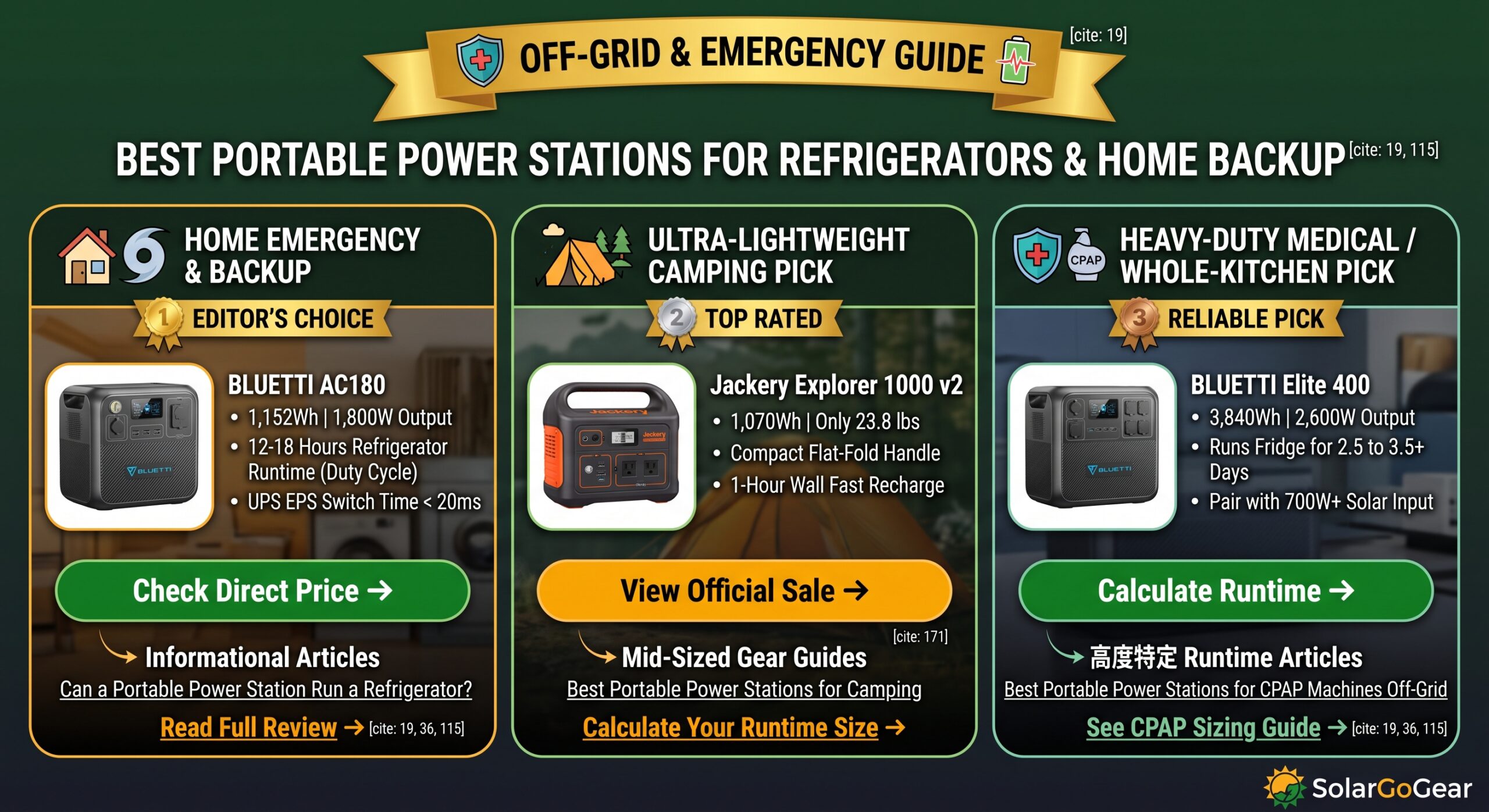
- BLUETTI AC180 (1,152Wh / 1,800W): Generates up to 2,700W Power Lifting surge to start heavy compressors with zero resistance and runs a full-sized fridge safely overnight.
- Jackery Explorer 1000 v2 (1,070Wh / 1,500W): Offers a massive 3,000W surge threshold at an ultra-lightweight 23.8 lbs profile.
2. Multi-Day Outages (2 to 5+ Days)
For severe weather, hurricanes, or winter storms where power stays out for multiple days, standard 1kWh batteries must be replenished daily with solar panels or upgraded to heavy-duty stationary capacity:
- BLUETTI Elite 400 (3,840Wh / 2,600W): Delivers sufficient storage to keep a standard kitchen refrigerator cycling for 2.5 to 3.5 continuous days on a single charge. Equipped with built-in wheels for rolling effortlessly between rooms.
- Jackery Explorer 5000 Plus (5,040Wh / 7,200W Peak): A whole-home emergency powerhouse capable of running a refrigerator, freezer, microwave, and medical devices simultaneously for up to 5 days.
4 Tips to Maximize Refrigerator Backup Time
- Keep the Doors Closed: Every time a refrigerator door opens, ambient room heat rushes in, forcing the compressor to run for up to 30 minutes straight.
- Turn Off the Ice Maker: In-door ice makers, heating defrost cycles, and ice dispensers draw extra electric loads that deplete emergency batteries unnecessarily.
- Use Solar Passthrough Charging: Connecting 200W to 400W of portable solar panels during daylight hours offsets the compressor’s draw completely, allowing you to run the appliance indefinitely off-grid.
- Use EPS / UPS Pass-Through: Units with an emergency power supply switchover (like the BLUETTI AC180’s $\le 20\text{ms}$ switch time) can stay plugged between the wall outlet and the fridge 24/7, engaging automatically during a blackout.