
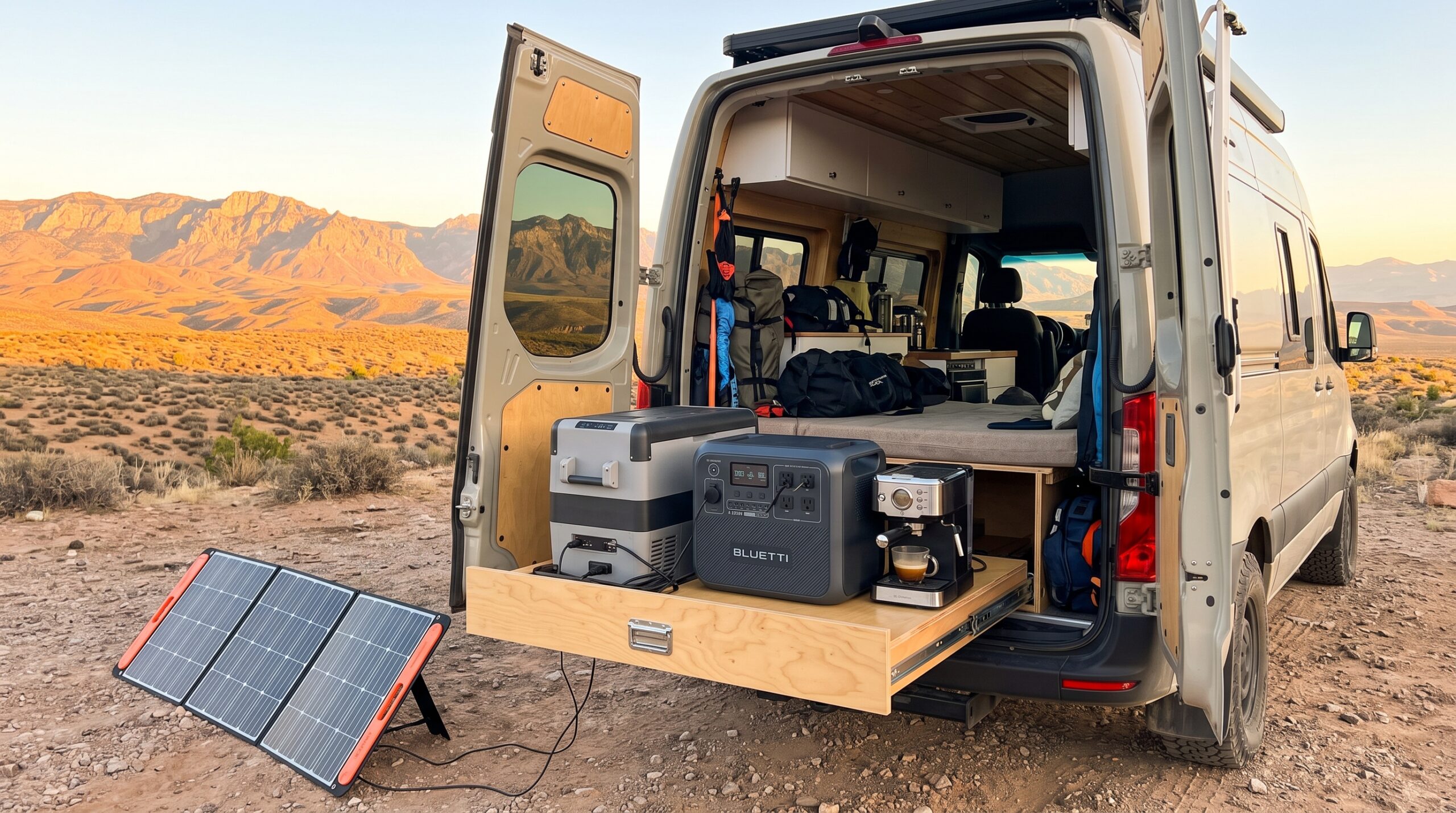
Powering off-grid trips requires a balance between portability, battery capacity, and charging versatility. Whether you are running a 12V compressor cooler inside a rooftop tent, charging drone packs at a campsite, or running induction cooktops in a campervan, selecting the right battery system eliminates dead-battery anxiety.
Modern LiFePO4 (lithium iron phosphate) and sodium-ion power stations deliver 3,000+ lifecycle charges, high-surge pure sine wave inverters, and rapid solar replenishment, making them essential replacements for loud gas generators.
Top Camping Power Stations: Real-World Specs & Comparison
🏕️ Best Camping Power Stations: Real-World Specs & Direct Deals
How to Size a Camping Power Station for Outdoor Gear
Power requirements vary significantly depending on whether you are packing light for a weekend tent trip or outfitting a full campervan build:
- Weekend & Tent Campers ($200\text{Wh} – 500\text{Wh}$): Ideal for charging smartphones ($15\text{W}$), laptops ($60\text{W}\text{–}100\text{W}$), running LED camp lighting, and powering a 12V portable fridge for single-night outings.
- Extended Van Life & Overlanding ($1,000\text{Wh} – 1,500\text{Wh}$): The sweet spot for multi-day trips. Easily sustains 12V compressor fridges for 3–5 days on duty cycle, powers CPAP therapy overnight, and handles medium kitchen gear like electric kettles.
- Full Van Conversions & Severe Cold ($1,500\text{Wh}+$): Required for induction cooking, built-in diesel heaters, Starlink terminals, and extreme winter camping.
Top Field-Tested Models for 2026
1. Best Ultra-Lightweight Tent Pick: BLUETTI Elite 30 V2
- Capacity & Inverter: $288\text{Wh}$ LiFePO4 | $600\text{W}$ AC Output ($1,500\text{W}$ Power Lifting)
- Weight: 9.5 lbs
- Key Strengths: Ultra-compact form factor with a built-in carry handle. Includes 140W USB-C two-way fast charging to recharge high-end laptops directly without bulky AC power bricks.
- Real-World Capability: Delivers 16–18 smartphone recharges or 10–12 hours of cooling runtime on an efficient 12V camping fridge.
2. Best Overall for Overlanding: Jackery Explorer 1000 v2
- Capacity & Inverter: $1,070\text{Wh}$ LiFePO4 | $1,500\text{W}$ Output ($3,000\text{W}$ Surge)
- Weight: 23.8 lbs
- Key Strengths: At under 24 lbs, it is roughly 11 lbs lighter than competing 1kWh stations. Its fold-down flat handle design packs flush into vehicle trunks and camper storage drawers.
- Real-World Capability: Runs a portable car fridge continuously for 3+ days while charging cameras, drones, and phones daily.
3. Best for Heavy Cooking & Power: BLUETTI AC180
- Capacity & Inverter: $1,152\text{Wh}$ LiFePO4 | $1,800\text{W}$ Continuous ($2,700\text{W}$ Power Lifting)
- Weight: 35.2 lbs
- Key Strengths: Delivers enough inverter output to handle standard kitchen appliances like portable microwaves, single-burner induction stoves, and coffee makers.
- Real-World Capability: Sustains off-grid camp setups with high-output $500\text{W}$ solar input, allowing 0–100% full solar recharging in roughly 3 hours of direct sun.
4. Best for Extreme Winter Camping: BLUETTI Pioneer Na
- Capacity & Inverter: $900\text{Wh}$ Sodium-Ion | $1,500\text{W}$ AC Output ($2,250\text{W}$ Power Lifting)
- Key Strengths: Traditional lithium batteries lose charging efficiency and capacity below freezing. Sodium-ion chemistry allows full discharge and recharge in temperatures as low as $-25^\circ\text{C}$ ($-13^\circ\text{F}$).
- Real-World Capability: Powers electric blankets, snow camp coolers, and Starlink systems reliably during extreme winter expeditions.
Practical Off-Grid Efficiency Tips
- Always Use 12V DC Outlets for Fridges: Converting $12\text{V}$ battery power up to $120\text{V}$ AC and back down through an appliance adapter wastes 15%–20% of stored energy. Plug 12V camping coolers directly into the DC cigarette port for maximum battery life.
- Pair with Portable Solar Panels: Connecting a 100W–200W foldable solar panel during daytime camp stops keeps your battery floating at 100%, enabling indefinite off-grid stays.
- Medical CPAP Sizing: If running a CPAP machine inside your tent, turn off heated humidification and heated tubes to reduce wattage draw from $60\text{W}$ down to just $15\text{W}\text{–}30\text{W}$.
Related Guides & Internal Links
- Explore our full breakdown on Portable Power Stations Master Category Hub.
- Sizing backup for medical devices? Read our Best Power Stations for CPAP Machines Off-Grid.
- Running coolers or home appliances? Check out Can a Portable Power Station Run a Refrigerator?