
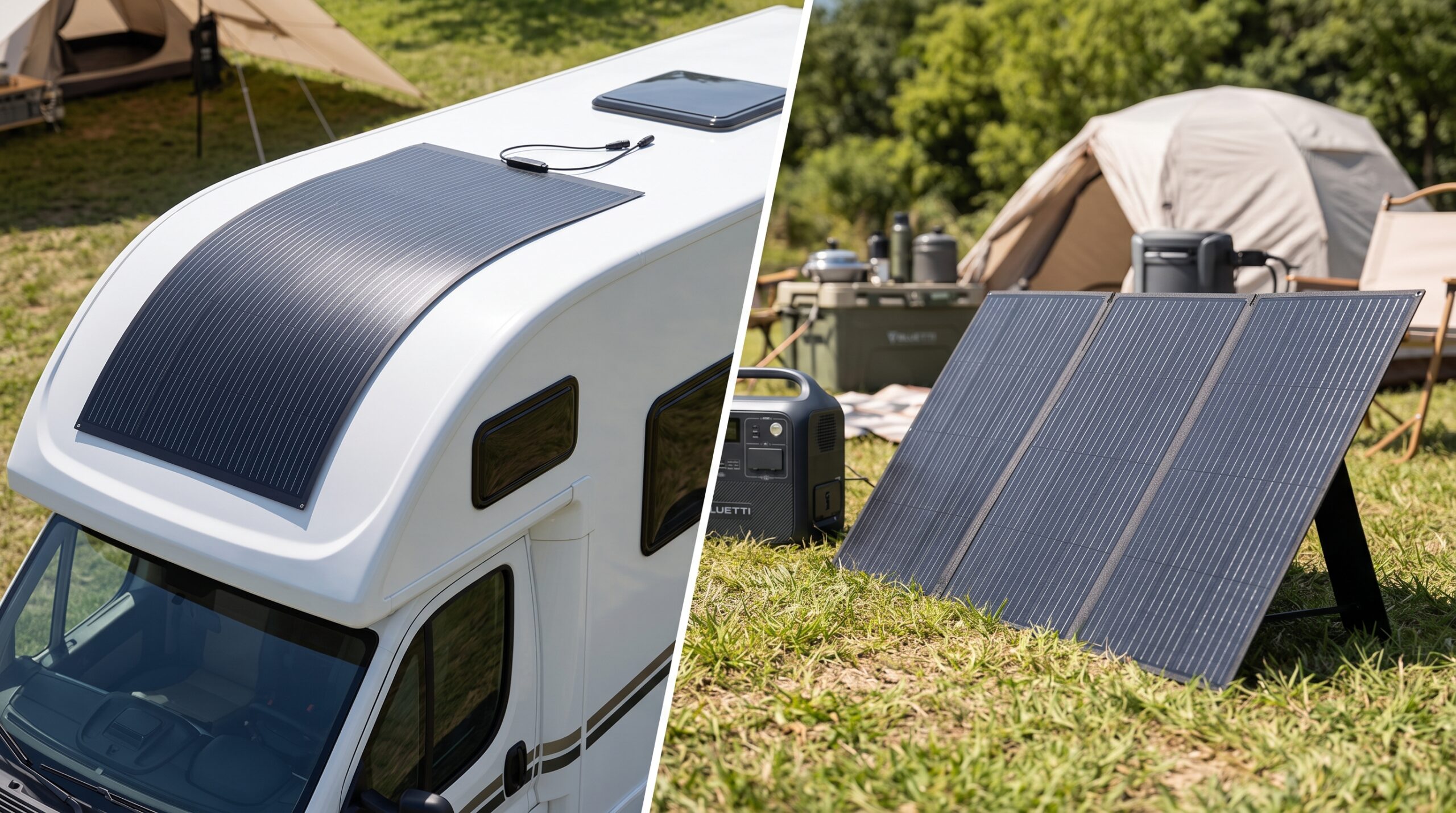
Choosing between foldable vs flexible solar panels comes down to how and where you generate power off-grid. While both designs eliminate the heavy aluminum frames of traditional rigid glass panels, they serve completely different mounting styles, travel setups, and camping needs.
Flexible solar panels, like the BLUETTI PV100 FX (100W), are built with an aerodynamic, bendable profile meant to mount flush on curved surfaces like RV roofs, camper vans, and teardrop trailers. In contrast, freestanding foldable panels (such as the BLUETTI SP100L or SP200L) feature built-in kickstands designed to be unpacked, angled toward direct midday sun, and packed away when traveling.
Head-to-Head Comparison: Flexible vs. Foldable Panels
⚡ Foldable vs. Flexible Solar Panels: Key Differences & Best Uses
Real-World Charging Performance
Both flexible and foldable panels use high-efficiency monocrystalline ETFE solar cells yielding 75% to 85% of their rated wattage in standard daylight:
- BLUETTI PV100 FX (100W Flexible): Produces approximately 70W to 80W when mounted flat on a vehicle roof. Because it stays mounted, it charges continuously while driving or parked, generating 350Wh to 400Wh over an average daylight run.
- BLUETTI SP100L (100W Foldable): Produces 75W to 85W when tilted directly toward the sun using its kickstands, generating 375Wh to 425Wh across 5 peak daylight hours.
Real-World Solar Charging Time Table
⚡ BLUETTI PV100 FX Flexible Panel: Real-World Solar Charging Capabilities
Which Style Fits Your Setup?
⚡ Which Style Should You Choose? Decision Breakdown
Flexible Panel Choose BLUETTI PV100 FX If:
- You want a low-profile installation on curved RV, camper van, teardrop, or boat surfaces without bulky roof racks.
- You need passive charging while driving on the highway without setting up gear at every stop.
- You want an ultra-lightweight panel (~4.4 lbs) that secures with structural adhesive, zip-ties, or pre-drilled eyelets.
Foldable Panel Choose BLUETTI SP100L / SP200L If:
- You camp in shaded areas and want to keep your vehicle in the shade while placing panels out in direct sun with an extension cable.
- You want the ability to adjust the tilt angle toward the sun throughout the morning and afternoon for peak wattage.
- You travel in multiple vehicles or want a portable pack that stores away inside a trunk or gear tote.
📚 Related Solar Guides & Official Deals
- ☀️ Foldable Panels Hub: Explore our Foldable Solar Panels Category Hub
- ⚡ Sizing Guide: 100W vs 200W Foldable Solar Panels: Which Size Do You Actually Need?
- 🔋 500W High Output Review: BLUETTI SORA 500 Review: Is a 500W Portable Solar Panel Worth It?
- 🏷️ Direct Brand Discounts: Verified BLUETTI Coupon Codes & Solar Generator Bundles